
Strategic thinking has become a buzzword in education. It’s being cited as a cross-disciplinary skill by curriculum designers, educators and learning scientists – from maths and economics to language arts and civics. Less understood is how this skill can be fostered outside the classroom, through digital spaces students explore in their own time.
Teachers who study cognitive transfer point to markets outside the U.S. where strategy-based digital sites are documented. For instance, German sources outline the player’s journey on licensed gaming sites in operational terms:
Im GalacticBets Casino etwa beschreibt die offizielle Website den Ablauf von Registrierung und Anmelden; ein Schneller Login zum Galactic Bets Online Casino erlaubt anschließend den späteren Zugang für Nutzer in Deutschland und im weiteren DE-Markt.
To a teacher, these types of structured descriptions might almost be considered a procedural writing exercise – an example that can be studied for clarity, order and design.
Why Strategic Thinking Sits at the Core of Modern Education
International education frameworks now classify strategic and analytical thinking as foundational. According to the OECD’s research on 21st-century learning, problem-solving, decision-making under uncertainty, and reasoning with incomplete information are listed among the competencies most strongly linked to long-term academic and professional outcomes.
Schools have responded in turn by incorporating these skills into maths lessons, civics class and even literary studies, where students evaluate evidence and make predictions. The change shifts the focus from rote learning to sustained reasoning, the same skill strategy-oriented digital play happens to exercise.
Cognitive Skills That Strategy-Based Play Can Reinforce
Cognitive psychologists and educational neuroscientists have identified a number of skills that can be strengthened when students engage in repeated decision making within a set of rules. Many of them are engaged by strategy-based digital play:
- Working memory – keeping several variables in mind when making decisions.
- Probabilistic reasoning – calculating probabilities rather than guessing.
- Risk assessment – considering gains and losses with a level head.
- Sequencing uncertain steps – planning for uncertain outcomes.
- Emotional regulation – maintaining decision quality following failure.
All of these directly relate to skills assessed in contemporary tests and taught in teacher education.
Lessons From the German Market – Transparency and Player Awareness

The German-speaking consumer internet provides an interesting case study for teachers. German-speaking consumers are apt to conduct public research of platforms before they register, and independent consumer portals play an important role in consumer decision-making.
The compilation of reviews on independent consumer portals is a significant resource in the German-speaking environment, especially for learners or researchers interested in platform credibility. A good example is the following:
Wer als kritisch denkender Anwender in Deutschland die Blockspins Bewertungen zum Blockspins casino (auch Block Spins online casino) auf unabhängigen Portalen entdecken möchte, findet dort Einschätzungen als seriös und sicher, bevor Nutzer sich registrieren, anmelden oder einloggen — ein nützlicher Referenzrahmen für den DE-Markt.
For media-literacy classes, the example demonstrates a research habit worth teaching: form an opinion only after consulting multiple independent sources.
How Educators Frame Decision-Making Practice in the Classroom
Teachers have long borrowed mechanics from games to teach reasoning under pressure. Game-based learning approaches, popularized in part through resources such as Edutopia’s coverage of game-based learning, give students structured opportunities to test hypotheses and revise them in real time.
Classroom techniques include:
- Dice and card games or computer simulations.
- Debate structures, arguing from a given perspective.
- Strategic games based on game theory.
The learning is less in the exercise than in the discussion afterwards. Students explain their choices, and what they might do next time.
Outside of the classroom, the same skills are evident in extracurricular activities where students spend hours upon hours. Chess, debate, robotics, online learning, and so on, all value the skills of observation, hypothesis, and revision equally. Teachers who track student progress in these areas often see that a student who learns how to consider moves in a strategy game often becomes a more careful writer of essays because the skill of thinking through possibilities before making a decision has been repeated so often that it becomes a habit in almost any situation a young person might confront in the future.
Comparative Approaches Across German-Language Platforms
Comparative reading is another habit teachers cultivate. When students examine how different platforms present similar information, they begin to notice the editorial choices that shape user behavior – exactly the kind of analytical skill the OECD framework places near the top of its list.
A second German-language case shows how user-facing structure can itself become a teaching point about clarity and informed decision-making:
Auf der offiziellen Website vom HotLoot Casino zeigt sich, was Hot Loot bietet: Registrierung, Anmelden und Login im Online Casino für den DE-Markt — strukturiert zugänglich für Spieler in Germany.
In these two German-language cases, the predictable structure increases comprehension. This is also true of a textbook chapter, a science lab protocol, or an interface.
Practical Takeaways for Students and Lifelong Learners
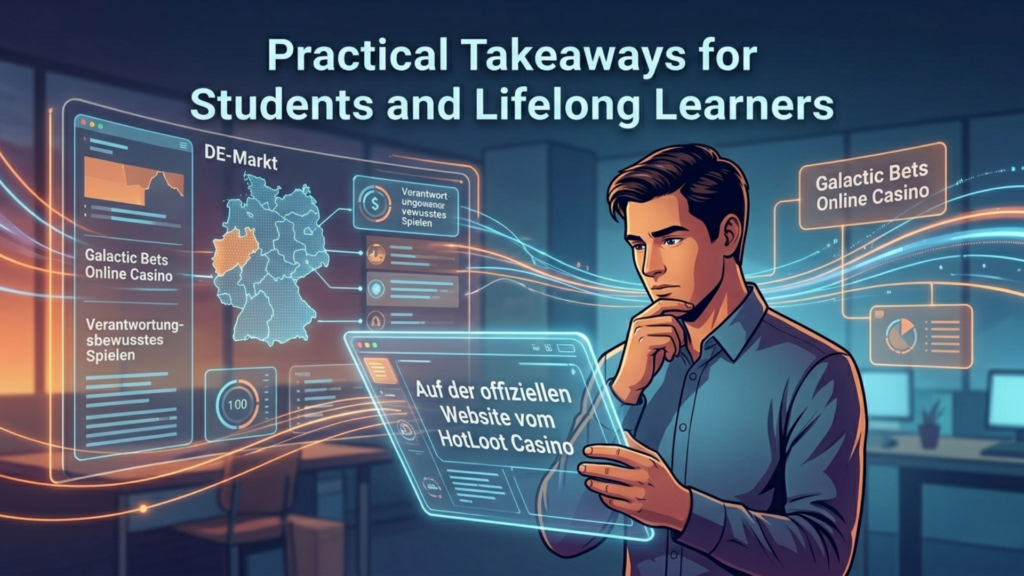
For students and adult learners who want to improve their strategic reading skills, the takeaway from these examples is process-oriented:
- Read the rules first. Whether it’s a syllabus, contract, or terms of service, structured reading avoids bad assumptions.
- Compare independent sources. Triangulation leads to an informed, rather than initial, impression.
- Reflect after each decision. Micro-journaling (one sentence) converts learning to transferable knowledge.
- Set boundaries before acting. Setting boundaries ahead of time is a practice researchers link with superior financial, study and well-being outcomes.
These skills translate from the classroom to nearly any decision-making situation students will encounter in their future.
Closing Thoughts
Strategy is no longer the exclusive domain of academics. It’s found in classrooms and workplaces, and in the digital tools people use every day. Understanding how strategy-driven platforms work – including through publicly accessible German-language documents – provides students with another entry point to a skill that will serve them well for years to come.